
The short version
- Ground every AI initiative in a measurable business outcome; if a leader cannot articulate the value, pause or reframe the project.
- Measure ROI across several dimensions – efficiency, revenue, cost avoidance, customer outcomes, risk – and balance quick wins against foundational investments and experiments.
- Build governance, testing, ethics, and cost management in from day one, then scale through repeatable patterns and a federated enablement model.
Introduction
Artificial Intelligence is no longer emerging. It is embedded. For CIOs and CTOs, the question is no longer “Should we invest in AI?” but “How do we maximize the value from the AI investments we’ve already made or are planning to make?”
The challenge isn’t just about implementing models or algorithms; it’s about aligning AI to business priorities, navigating organizational complexity, and delivering measurable outcomes. Many enterprises over-invest in proof-of-concept initiatives that don’t scale, or they struggle to quantify value after deployment.
This guide lays out a practical approach to defining, prioritizing, and governing AI initiatives across the enterprise, rooted in strategic frameworks, sustainable ROI measurement, and real-world lessons.
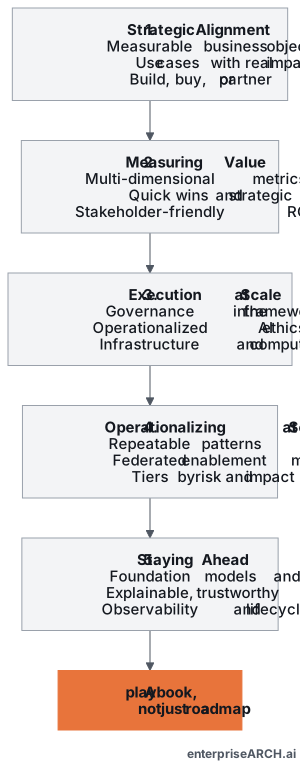
1. Strategic Alignment: Avoiding AI for AI’s Sake
Start With Measurable Business Objectives
AI must serve a purpose beyond experimentation. Initiatives should be grounded in well-defined outcomes tied to strategic priorities such as:
- Improving customer lifetime value through hyper-personalized engagement
- Reducing operational cost through predictive automation
- Enhancing risk posture via real-time anomaly detection
If a business leader cannot articulate the value an AI project is expected to deliver, the project should be paused or reframed.
Prioritize Use Cases With Real Impact
All use cases are not created equal. High-value initiatives share three traits:
- Strategic relevance to the business’s goals (e.g., margin improvement, risk mitigation)
- Data readiness and quality to support model development
- Operational feasibility for deployment and adoption
A regional bank, for instance, might prioritize fraud detection over chatbot automation because of the higher cost savings and reputational risk reduction.
Assess Organizational and Technical Maturity
Before launching any initiative, ask:
- Is our data clean, labeled, and accessible at scale?
- Do we have MLOps capabilities to support model lifecycle management?
- Are the affected teams prepared for operational change?
Organizational readiness, not just data science skill, is often the gating factor to enterprise AI success. Embedding AI into daily workflows and processes requires change management, training, and executive sponsorship.
Align AI Within the Enterprise Architecture
AI should not exist in isolation. Enterprise architects must ensure AI capabilities integrate cleanly with existing systems such as ERP, CRM, data lakes, and APIs. Reference architectures should be updated to include:
- AI model registries as part of enterprise service catalogs
- Data lineage tracking embedded in data integration layers
- Shared components for model inference accessible via microservices
AI capabilities must work within the broader architecture strategy to avoid siloed deployments.
Define a Sourcing Strategy: Build, Buy, or Partner
Technical executives should align AI use cases with sourcing models. Consider:
- Build: When differentiation, proprietary data, or agility is required
- Buy: For commoditized AI capabilities or cost-effective tooling
- Partner: When co-innovation or niche expertise accelerates value
Each approach carries implications for speed, IP control, and long-term cost structure.
Develop a Talent Strategy Aligned to Your Operating Model
Technical capabilities often constrain AI ambition. A talent plan should:
- Define required roles (data engineers, ML engineers, AI product managers)
- Assess current skill levels and identify gaps
- Include reskilling and upskilling pathways
- Explore external augmentation (contractors, vendors, managed services)
Embed AI capability maturity into your workforce planning cycle.
2. Measuring Value: Defining and Tracking AI ROI
AI’s value can be elusive, especially when results unfold over time or impact intangible outcomes like customer trust. That’s why AI ROI requires a blended measurement approach.
Use a Multi-Dimensional Metric Framework
Move beyond one-dimensional KPIs. A well-rounded AI initiative will affect several axes:
| Metric Category | Sample Measures |
|---|---|
| Efficiency | Reduction in time-to-decision or rework |
| Revenue Impact | Upsell rate, conversion lift, CLTV |
| Cost Avoidance | Downtime reduction, fraud prevention savings |
| Customer Outcomes | NPS, engagement rate, support resolution time |
| Risk Reduction | Compliance improvement, exposure reduction |
Tracking these over time allows leaders to articulate both hard ROI and strategic value creation.
Balance Quick Wins and Strategic Bets
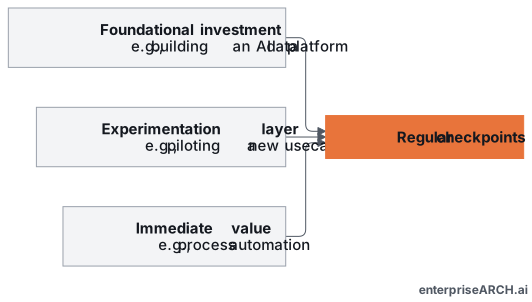
Not all initiatives will generate returns in 3 to 6 months. That’s OK, as long as stakeholders understand:
- What’s a foundational investment (e.g., building an AI data platform)
- What’s an experimentation layer (e.g., piloting a new use case)
- What’s positioned for immediate value (e.g., process automation)
Leaders should maintain a pipeline of initiatives across these horizons, backed by regular checkpoints.
Link AI to Portfolio and Capital Planning
AI initiatives should align with the enterprise’s broader funding strategy. This means:
- Mapping AI projects to capital allocation models
- Ensuring AI programs have defined business cases during strategic portfolio reviews
- Tracking both hard-dollar ROI and value creation aligned with OKRs
Communicate ROI in Stakeholder-Friendly Language
Translating technical success into business value is key to sustained support. Use:
- Financial metrics (margin lift, reduced service cost)
- Operational KPIs (efficiency, speed-to-insight)
- Strategic alignment indicators (competitive differentiation, regulatory strength)
Develop board-level scorecards to visualize AI value across time horizons.
3. Execution at Scale: Governance, Ethics, and Sustainability
AI adoption brings risk, both technical and reputational. CIOs and CTOs must ensure responsible AI practices are built in from day one, not tacked on later.
Build Governance Into the Framework
- Model Management: Track model lineage, accuracy drift, and retraining cycles with MLOps practices.
- Auditability: Ensure decisions can be explained and reviewed, especially in regulated industries.
- Ownership: Assign clear accountability for each stage, from data prep to model inference to feedback loop integration.
Incorporate Testing and Validation Standards
Enterprise AI requires more than unit tests. Build confidence through:
- A/B testing and canary deployments
- Model validation against fairness and robustness metrics
- Synthetic data testing for edge cases
Ensure that your testing pipelines support explainability and reproducibility.
Operationalize AI Ethics
Embed ethical checkpoints at three layers:
- Design: Use representative datasets, conduct bias impact assessments
- Deployment: Apply explainability methods like SHAP, LIME, or counterfactuals
- Oversight: Define escalation and audit procedures for high-risk decisions
Proactive ethics governance must be tied to operational practices, not policy docs.
Address Industry-Specific Compliance Requirements
Align AI programs to industry regulations such as:
- HIPAA in healthcare
- GDPR in Europe
- GxP in life sciences
- SR 11-7 for model risk in financial services
Manage Infrastructure and Compute Costs
With large model adoption rising, cost governance is critical:
- Track GPU usage and training spend
- Optimize for batch vs. real-time inference
- Use serverless and spot instances where applicable
Consider cost per inference and model retraining ROI in your platform design.
Recognize and Plan for AI Failure Modes
Common issues include:
- Model drift and performance decay
- Data quality degradation
- Regulatory challenges due to opaque decisions
Design observability and retraining workflows upfront.
4. Operationalizing AI at Scale: From Pilot to Enterprise-Wide Impact
Build Repeatable Patterns, Not One-Off Projects
Create reusable workflows with:
- Feature stores
- Shared model registries
- Modular data and ML pipelines
Standardization accelerates time-to-value and lowers technical debt.
Invest in Change Enablement, Not Just Tech
Focus on:
- Productizing AI into operational systems
- Empowering non-technical users with AI outputs
- Building trust in AI outcomes across business lines
Establish a Federated AI Enablement Model
Balance central control with local agility by:
- Defining platform standards centrally
- Embedding AI leads into business units
- Creating shared KPIs across roles
Categorize and Tier AI Initiatives by Risk and Impact
| Tier | Type | Characteristics |
|---|---|---|
| 1 | Core Business Transformation | Enterprise-wide value creation |
| 2 | Embedded AI Features | Operational integration |
| 3 | Innovation / R&D | High uncertainty, potential differentiation |
5. Staying Ahead: What’s Next in Enterprise AI
Adopt and Operationalize Foundation Models and LLMs
Consider:
- Fine-tuning or prompt-tuning open models (e.g., Mistral, LLaMA)
- Using retrieval-augmented generation (RAG) with vector databases
- Building domain-specific copilots in secure environments (e.g., Azure OpenAI)
Invest in Explainable and Trustworthy AI
Use:
- SHAP, LIME, counterfactual explanations
- Confidence scoring and abstention mechanisms
- Human-in-the-loop review pipelines
Build AI Observability and Lifecycle Management
Track:
- Model telemetry (latency, throughput, failure rates)
- Drift detection and auto-retraining triggers
- AI bill of materials (AI-BOM) for compliance traceability
Align with Data-Centric AI Principles
Shift effort from tuning models to improving datasets:
- Use labeling tools and automated quality checks
- Analyze data diversity and edge-case representation
- Reward teams for dataset curation outcomes
Conclusion: Create a Playbook, Not Just a Roadmap
AI success requires more than ambition. It needs systems thinking, enterprise discipline, and technical rigor. That means:
- Anchoring every initiative in business outcomes
- Prioritizing based on feasibility, impact, and risk
- Building governance, infrastructure, and talent readiness
- Communicating impact in terms executives and regulators understand
With these practices, CIOs and CTOs can move beyond experimentation and deliver real, sustainable transformation.