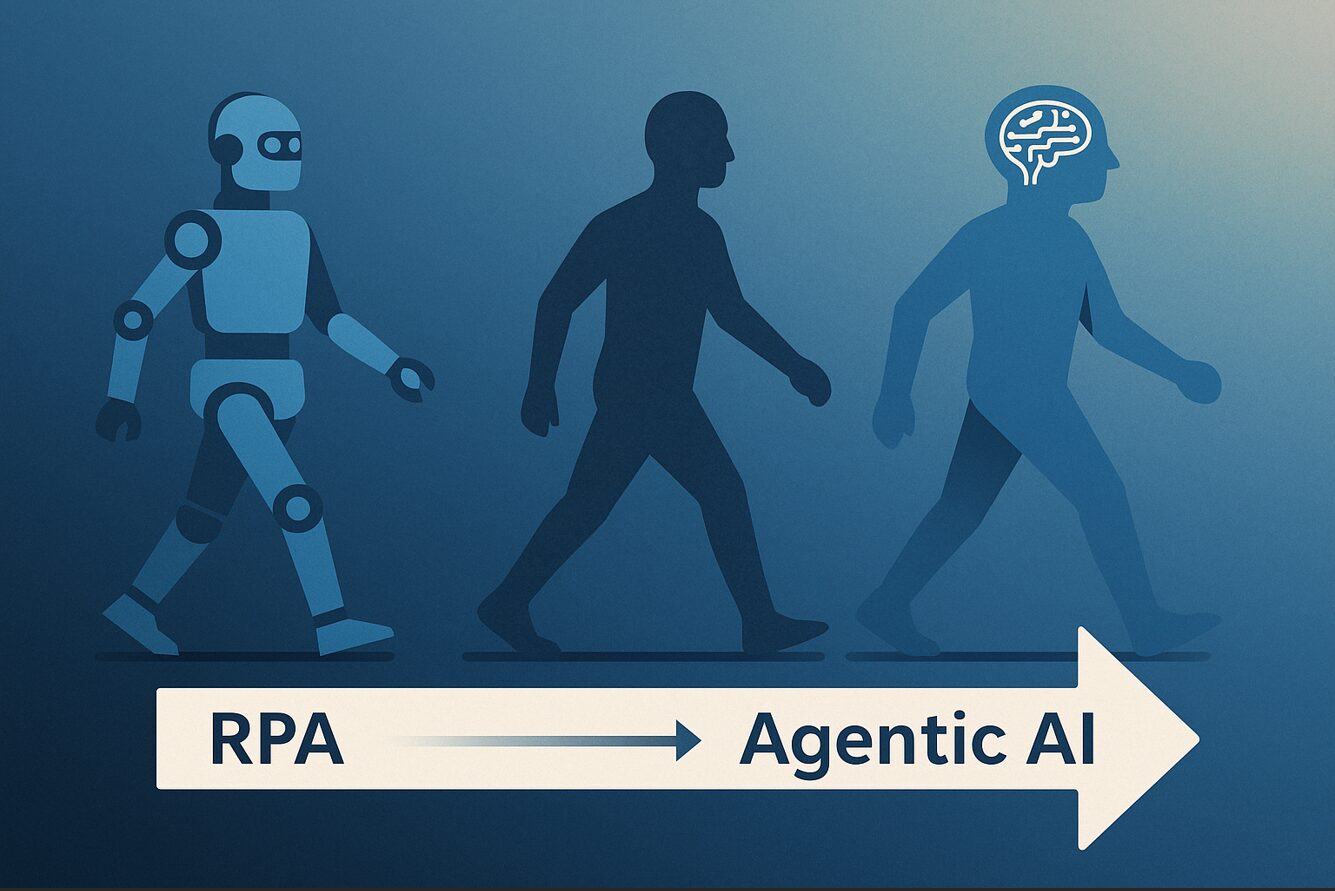
From Automation to Autonomy: Why Agentic AI Is the Next Evolution of RPA

Over the last decade, we’ve all watched Robotic Process Automation (RPA) mature from a buzzword into a mainstay of business operations. Tools like Power Automate, Blue Prism, and UiPath have been quietly working behind the scenes, helping teams streamline workflows, cut down on manual tasks, and improve consistency. They’re rule-followers – good ones, too.

But we’re entering a new era.

As organizations become more AI-centric, the next leap forward isn’t just about faster automation – it’s about machines that can act with intent, judgment, and adaptability. Welcome to the world of agentic AI.

What Is Agentic AI – and How Is It Different from RPA?

Think of RPA as a very diligent assistant: it will do exactly what you ask it to do, step by step, without deviation. Want it to move an invoice from one system to another every time it shows up in an inbox? Perfect. It’ll never forget. But it also won’t handle a novel situation unless someone updates the flow.

Agentic AI, on the other hand, is more like a junior colleague with initiative. You give it a goal, and it figures out how to achieve that goal – even if the path isn’t perfectly defined. It reasons, learns, adapts, and can even re-plan when it encounters something unexpected.

That’s a profound shift. We’re moving from automation to autonomy.

If you want to add a philosophical philosophical definition:

  • Traditional RPA is about doing what it’s told. It is Kantian: “Act according to a rule.”
  • Agentic AI is about figuring out what to do to achieve a desired outcome. It is Pragmatist / Post-Kantian: “Figure out what works in the real world with imperfect information.”

Key qualities of RPA:

  • Rule-based
  • Deterministic
  • Works well for structured, repetitive tasks
  • Needs detailed, upfront modeling
  • Follows linear workflows, almost like flowcharts with conditional logic

Key qualities of agentic AI

  • Goal-oriented rather than task-oriented – humans set the agent’s goals, but they in turn act independently to achieve those goals, adapting their strategies if necessary.​
  • Can reason, re-plan, and adapt – agents reason through ways and methods to accomplish their goals and create a plan of actions to complete complex tasks.​
  • Long Term Memory and Reflection – Agents learn and remember past interactions to better understand intention and context to drive optimized decision making.
  • Less deterministic – more probabilistic and contextual
  • Can handle ambiguity and interact across complex systems dynamically
  • Capable of multi-step planning with autonomy, not just automation – agent communication capabilities (e.g., APIs) enable multi-agent configurations that work together to drive end-to-end business functions.​

Why This Shift Matters for Organizations

In practical terms, agentic AI means your systems can:

  • Respond to changing business conditions without constant reprogramming
  • Work across silos to complete multi-step objectives
  • Handle ambiguity in a way traditional automation simply can’t

For example, instead of building a detailed workflow to triage customer support tickets based on topic, urgency, and account type, you could ask an AI agent to “make sure every high-value client gets a response within 30 minutes.” The agent can determine how to do that in real-time – triaging, escalating, even rewriting communications if needed.

This gives you scalability without creating a spaghetti mess of conditional logic and exception handling.

What’s Driving the Shift to Agentic AI?

Several factors are converging at once:

  • AI models have become vastly more capable, especially at understanding natural language and complex instructions
  • Business complexity is increasing, and rigid automation often breaks under shifting priorities or exceptions
  • Leadership is pushing for agility and innovation, not just cost savings

Put simply: the old automation playbook is hitting its limits.

Agentic AI offers a more flexible, intelligent, and resilient approach – particularly useful in fast-moving, high-change environments like finance, healthcare, and customer service.

What It Means for Your Teams

This evolution has direct implications on your workforce and organizational readiness.

Here’s what to expect:

  • New Skills: Teams will need to learn how to work with AI agents – not just configure workflows, but frame goals and evaluate performance.
  • Upskilling Opportunities: Expect training demand in areas like prompt engineering, AI monitoring, and ethical oversight.
  • Cross-Functional Collaboration: Business users, process owners, and IT teams will need tighter collaboration to ensure the AI is doing what the business actually wants.
  • Change Management: Some roles will shift from “task executor” to “AI supervisor” – managing agents, reviewing edge cases, and improving feedback loops.

This isn’t a mass displacement story. It’s a story of elevation and adaptation.

Getting Started with Agentic AI in Azure and the Microsoft Ecosystem

As a consultant specializing in Microsoft technology, I thought it fitting to include a high level nod towards getting your organization started in the desmense in which I am most familair. If you’re already using Microsoft tools like Power Platform, Azure, and Microsoft 365, you’re in a strong position to explore agentic AI. Microsoft has been weaving AI into nearly every part of its ecosystem – and they’re building for this future.

Here’s how to begin your journey:

1. Identify High-Value, Loosely Structured Workflows

Look for business processes that:

  • Involve multiple steps or decisions
  • Require context or judgment
  • Are difficult to fully script in traditional automation

Examples might include sales follow-ups, support triage, vendor onboarding, or contract review.

2. Use Azure AI Services and Copilots

Microsoft has made it easy to tap into advanced AI via tools like:

  • Azure OpenAI Service – Use large language models to power reasoning, summarization, and decision-making tasks.
  • Power Platform Copilots – Add AI-powered capabilities to workflows in Power Automate or Power Apps without needing deep coding expertise.
  • Microsoft 365 Copilot – Integrate goal-driven agents into productivity apps like Outlook, Word, and Teams.

3. Create Your First Agentic Pattern

In Azure, an agentic solution might look like:

  • A goal or objective defined in natural language
  • A prompt orchestration layer using tools like Azure Functions or Logic Apps
  • Calls to OpenAI or Azure AI models to reason, plan, and decide
  • Integration with business data sources via Microsoft Graph, Dataverse, or APIs
  • Oversight via Azure Monitor or Power BI dashboards to track outcomes

You’re not replacing RPA here – you’re layering intelligent, adaptive logic on top of it.

Final Thoughts: Is Agentic AI Right for You?

Agentic AI isn’t a replacement for everything you’ve built – it’s an expansion of what’s possible.

Start small. Find one or two processes within your organization where rigid automation struggles. Add AI to help interpret, decide, or adapt. You’ll learn fast, and your teams will start seeing what’s possible when software doesn’t just follow instructions – it thinks.

This is more than a new toolset. It’s a new organizational capability. And those who build it early will be the ones who thrive in the next chapter of digital transformation.


Author

  • Ron Sparks

    Ron Sparks is an enterprise architect and technical consultant based in Pittsburgh, PA. With decades of experience across cloud, infrastructure, and strategy, he helps organizations bridge business goals with practical tech solutions. A head and neck cancer survivor, Ron is also a poet, motorcycle enthusiast, world traveler, and whiskey aficionado.