The short version
- AI is enhancing low-code platforms rather than replacing them, and Microsoft’s recent Copilot updates let developers focus on higher-value tasks.
- Digital twins and industrial robotics, as in Accenture’s work with Schaeffler, are moving manufacturing toward autonomous factories and human-robot collaboration.
- AI-driven threat detection is becoming standard; leaders should prioritize low-code/AI platforms, digital twins, and AI-enhanced security.
The Future of Tech: AI-Driven Transformation in Development, Infrastructure, and Security
The last two weeks have brought exciting developments. Here are three key trends shaping the future of application development, infrastructure, and security—powered by innovations from #Microsoft and #Accenture:
1. AI-Enhanced Application Development
Low-code/no-code platforms are becoming indispensable for accelerating software delivery. According to the 2025 App Development Trends Report, 95% of companies now use these tools, with AI poised to enhance their efficiency rather than replace them. This convergence of AI with low-code enables faster app delivery while democratizing development across organizations.
Microsoft’s recent updates to its Copilot AI assistant further amplify this trend. With features like memory management, multi-agent systems, and real-time assistance, Copilot is transforming into a proactive AI companion that empowers developers to focus on higher-value tasks while leveraging AI for operational efficiency
2. Infrastructure Innovation Through Digital Twins and Robotics
Accenture’s collaboration with Schaeffler AG showcases how digital twins and industrial humanoid robots are revolutionizing manufacturing. By combining NVIDIA’s simulation technology with Microsoft Fabric’s AI-powered data platform, organizations can optimize workflows, predict bottlenecks, and enhance operational efficiency in real-time. This represents a significant leap toward autonomous factories and human-robot collaboration.
3. Security: AI as the New Frontline
Cybersecurity is evolving rapidly with AI at the helm. Advanced threat detection through real-time analytics and predictive capabilities is becoming standard. AI-driven systems now monitor environments autonomously, reducing manual intervention and enabling faster response times to threats. For enterprises navigating hybrid cloud environments or scaling IoT deployments, these advancements are critical.
What Does This Mean for Leaders?
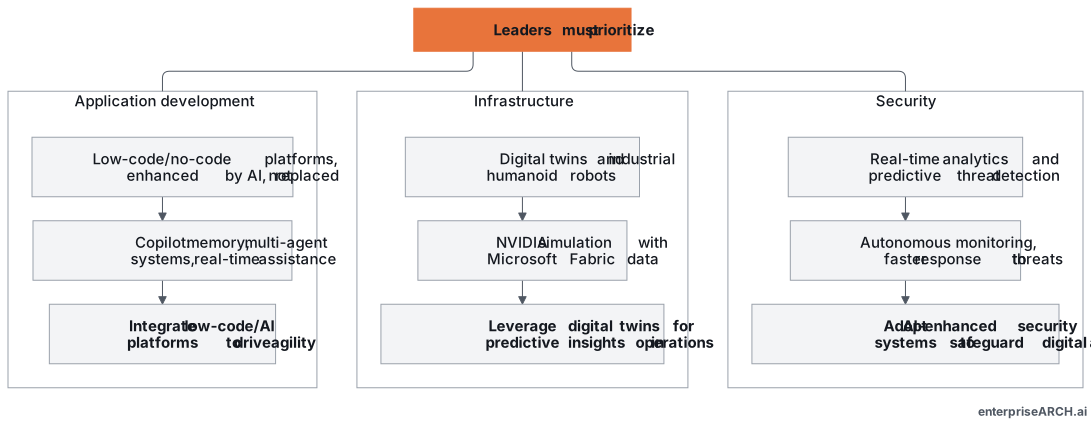
These advancements highlight a shift toward AI-first strategies across application development, infrastructure management, and security. Leaders must prioritize:
- Integrating low-code/AI platforms to drive agility.
- Leveraging digital twins for predictive insights in operations.
- Adopting AI-enhanced security systems to safeguard digital assets.
As Microsoft celebrates its 50th anniversary with groundbreaking Copilot updates and Accenture pushes the boundaries of automation with physical AI, it’s clear that innovation is accelerating at an unprecedented pace. The question is no longer if but how fast organizations can adapt to these changes.
How are you preparing your teams to thrive in this new era of autonomy and intelligence?
#AI #DigitalTransformation #ApplicationDevelopment #Infrastructure #Cybersecurity #Leadership